






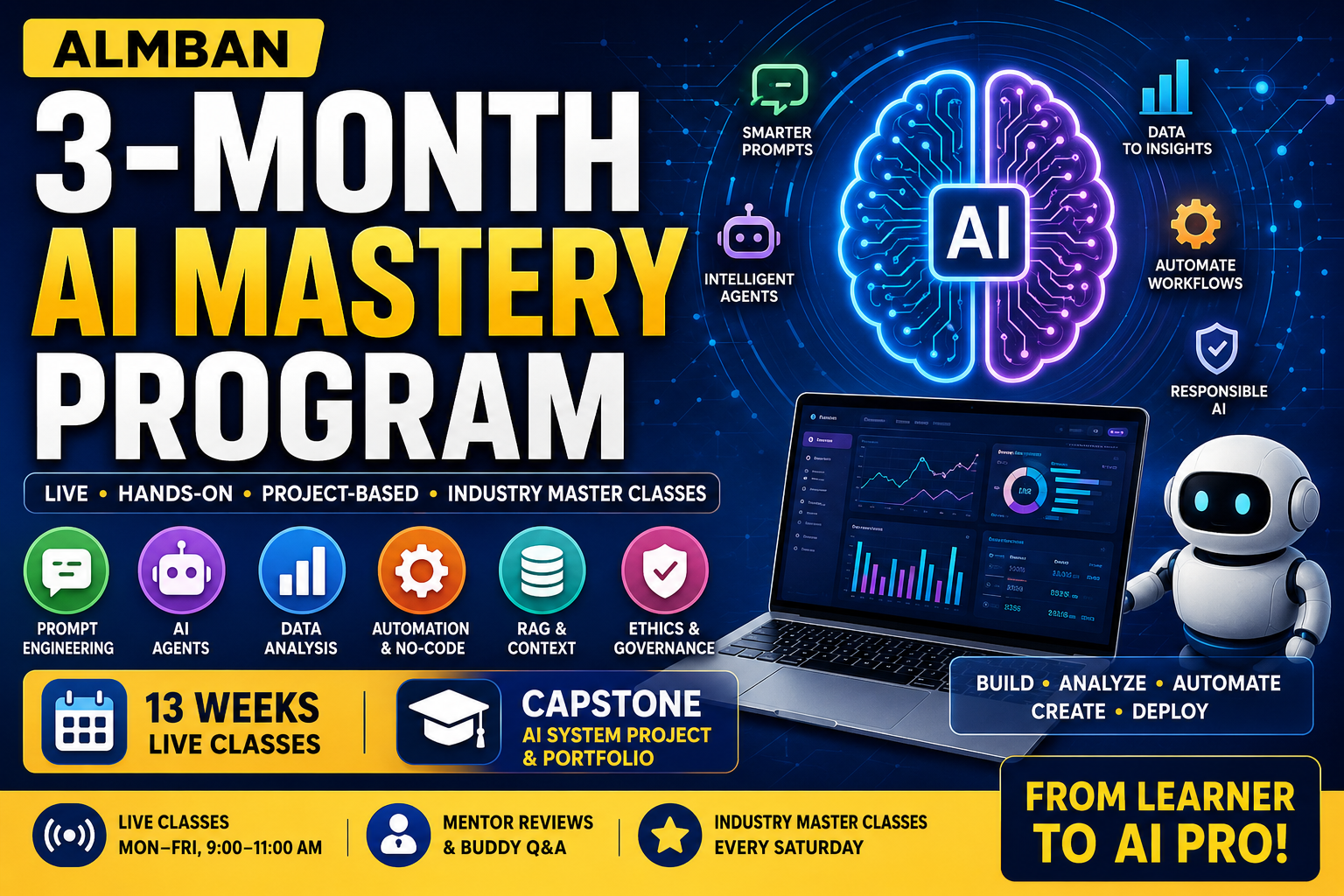
AI 3-Months Mastery Program (Overview)
The pedagogy is deliberately practitioner-first. Theory is introduced only where it changes what you build. Every concept is paired with a hands-on demonstration in at least one of seven leading LLM platforms.

Instructor
What Will You Learn?
About This Course
The Learning Journey — 8 Milestones
Each milestone is a measurable shift in capability. By the end of the course, the student has crossed all eight.
- AI Literacy — Understand what AI is and is not.
- Prompt Understanding — Engineer prompts that produce reliable outputs.
- Research & Creativity — Use AI for academic, creative, and visual work.
- Workflow Automation — Replace repetition with co-pilot pipelines.
- AI Agents — Architect autonomous, tool-using systems.
- RAG Systems — Ground AI in verified knowledge to eliminate hallucination.
- Ethics & Strategy — Deploy AI safely and align it with organizational goals.
- AI-Ready Graduate — Demonstrate all of the above in a portfolio Capstone.
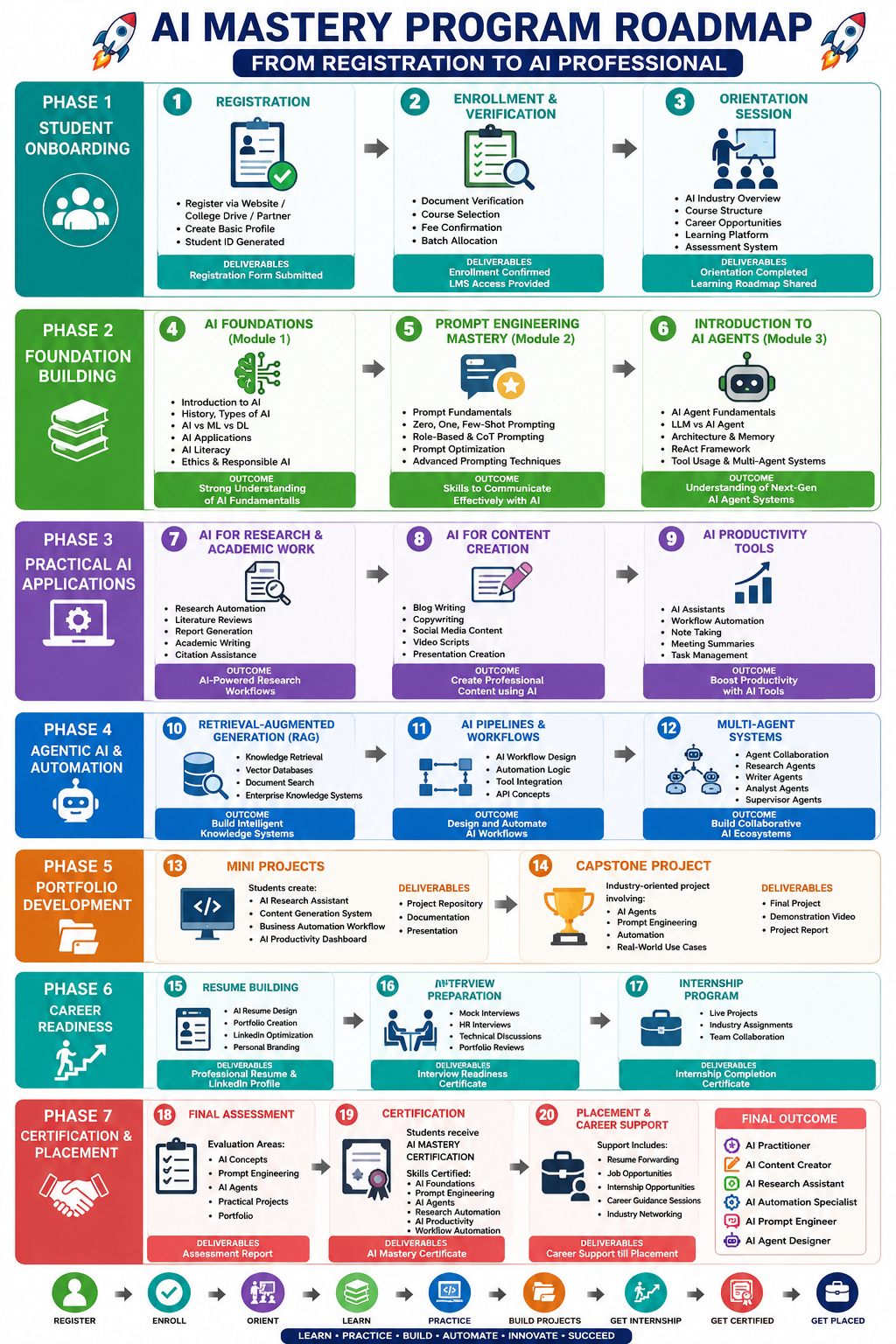
Course Architecture — 6 Units, 18 Modules
Unit | Theme | Modules | Unit Output |
Unit 1 | Foundations of AI & Prompt Engineering | 1. AI Basics & AI Literacy 2. Prompt Engineering Mastery 3. Introduction to AI Agents | Conceptual First AI Agent (No-Code) |
Unit 2 | Research, Writing & Data | 4. AI for Research & Academic Work 5. AI in Excel & Data Understanding 6. Data Analysis using AI | AI-Assisted Research Workflow |
Unit 3 | Creative AI | 7. AI for Image Generation 8. AI for Video & Audio Creation 9. Creative Prompt Engineering | Creative AI Asset Pack |
Unit 4 | Automation & No-Code AI | 10. Automation Mindset 11. AI as Workflow Co-Pilot 12. Multi-step AI Reasoning Systems | Autonomous AI Agent |
Unit 5 | RAG & AI Search | 13. RAG Fundamentals 14. Context Injection & Prompt Templates 15. AI Search Optimization | RAG-Powered AI Agent |
Unit 6 | Ethics, Strategy & Capstone | 16. AI Safety & Ethics 17. AI Strategy & Deployment 18. Capstone System Development | Capstone AI System (Portfolio) |
Requirements

Trusted Companies
+3200 Companies trusted our courses for their staff tutoring

FAQ
Check the frequently asked questions about this course.
Manish Sharma

Curriculum Overview
This course includes 6 modules, 26 lessons, and 16:00 hours of materials.
Foundations of AI & Prompt Engineering provides learners with a strong introduction to Artificial Intelligence and the essential skills required to work effectively with modern AI technologies. It covers the fundamentals of AI, AI literacy, prompt engineering techniques, and the basics of AI agents. Through practical examples and hands-on learning, learners develop the ability to interact with AI tools efficiently, create effective prompts, and understand how intelligent AI systems function. This unit lays the foundation for the advanced concepts and applications explored throughout the AI Mastery Program.
This course transforms a beginner into an AI-Ready Graduate by 2026 — not by lecturing about AI, but by building, prompting, automating, and deploying with it. Every module ends with a tangible artifact. Every unit produces a deliverable. The course closes with a portfolio-ready Capstone AI System.
The pedagogy is deliberately practitioner-first. Theory is introduced only where it changes what you build. Every concept is paired with a hands-on demonstration in at least one of seven leading LLM platforms.
Prompt Engineering is the process of designing, writing, and refining clear instructions (called prompts) to help AI models generate accurate, relevant, and useful responses. It involves choosing the right words, providing context, setting constraints, and specifying the desired format so the AI understands exactly what is expected.
Prompt engineering enables users to get better results from AI tools for tasks such as content writing, coding, research, data analysis, image generation, lesson planning, and business automation.
Key Elements of a Good Prompt
Clear Objective: State exactly what you want the AI to do.
Context: Provide background information or relevant details.
Specific Instructions: Mention the desired tone, style, length, or format.
Constraints: Include any limitations, such as word count or audience.
Examples (Optional): Give sample inputs or outputs for better accuracy.
Benefits of Prompt Engineering
Improves the quality and accuracy of AI-generated responses.
Saves time by reducing the need for multiple revisions.
Produces consistent and structured outputs.
Enhances creativity and problem-solving.
Makes AI more effective for educational, professional, and business tasks.
Example
Basic Prompt:
Explain photosynthesis.
Well-Engineered Prompt:
Explain photosynthesis for Grade 6 students in simple English. Use bullet points, include a real-life example, and keep the explanation within 150 words.
The second prompt provides clear instructions, allowing the AI to produce a more focused and useful response.
Applications of Prompt Engineering
Content writing and editing
Programming and debugging
Research and summarization
Lesson planning and education
Marketing and social media
Customer support
Data analysis and reporting
Image and video generation using AI
In summary: Prompt engineering is the skill of communicating effectively with AI by creating precise and well-structured prompts, enabling the AI to deliver high-quality, relevant, and efficient results.
This module introduces learners to the next generation of Artificial Intelligence—AI Agents. Students will explore how AI evolves from simple prompt-based interactions to intelligent, autonomous systems capable of reasoning, planning, using tools, retaining memory, and executing multi-step tasks.
The module covers the fundamentals of AI Agents, their architecture, memory systems, ReAct framework, tool integration, and multi-agent collaboration. Learners will also understand the differences between Large Language Models (LLMs) and AI Agents, explore real-world applications of Agentic AI, and gain insight into the opportunities and limitations of autonomous AI systems.
By the end of this module, students will be able to understand how modern AI agents are designed, how they interact with external tools and knowledge sources, and how they power intelligent automation across industries. This module provides a strong foundation for building advanced AI workflows and agent-driven applications.
Learning Outcomes
Upon successful completion of this module, learners will be able to:
Understand the concept and evolution of AI Agents.
Differentiate between LLMs and AI Agents.
Explain the architecture and components of intelligent AI agents.
Understand memory systems and the ReAct reasoning framework.
Explore tool usage and multi-agent collaboration.
Identify real-world applications, challenges, and future trends in Agentic AI.
This module serves as a bridge between foundational AI knowledge and the practical development of intelligent, autonomous AI systems.
AI for Research, Productivity & Data equips learners with practical skills to use Artificial Intelligence for academic research, workplace productivity, and data analysis. It covers AI-assisted research, Excel-based data management, and AI-powered data analysis techniques, enabling learners to organize information, generate insights, automate routine tasks, and make data-driven decisions. This unit helps learners enhance efficiency, improve analytical thinking, and apply AI effectively in academic, business, and professional environments.
This module equips learners with the skills to leverage Artificial Intelligence for academic research, professional writing, and knowledge management. Students will discover how AI can simplify the research process by assisting with topic exploration, literature reviews, information synthesis, academic writing, citation management, and presentation creation.
Learners will explore AI-powered tools and techniques for conducting high-quality research, organizing information, generating reports, summarizing complex documents, and enhancing productivity while maintaining academic integrity. The module also emphasizes the ethical use of AI in research, including fact-checking, plagiarism awareness, proper citation practices, and responsible AI-assisted content creation.
By the end of this module, students will be able to integrate AI into their academic and research workflows, enabling them to produce well-structured, accurate, and impactful research outputs while saving time and improving efficiency.
Learning Outcomes
Upon successful completion of this module, learners will be able to:
Conduct AI-assisted research efficiently using modern AI tools.
Perform literature reviews and gather information from reliable sources.
Generate academic reports, research papers, and project documentation with AI assistance.
Summarize, analyze, and organize complex research materials.
Create professional presentations and academic content using AI.
Apply proper citation methods and avoid plagiarism.
Verify AI-generated information through fact-checking and critical evaluation.
Use AI ethically and responsibly in academic and research environments.
This module prepares learners to become confident, ethical, and productive researchers by combining traditional research methodologies with the power of modern Artificial Intelligence.
This module introduces learners to the powerful combination of Artificial Intelligence and Microsoft Excel for data analysis, visualization, and decision-making. Students will learn how AI can simplify working with spreadsheets by automating repetitive tasks, analyzing datasets, generating formulas, creating charts, and uncovering valuable insights from data.
The module covers the fundamentals of data understanding, including data collection, cleaning, organization, analysis, and interpretation. Learners will explore AI-powered Excel features and modern AI tools that assist in formula generation, data summarization, trend identification, dashboard creation, and predictive analysis.
Through hands-on activities and real-world datasets, students will develop practical skills in transforming raw data into meaningful information, enabling smarter business and academic decisions. The module also emphasizes data accuracy, visualization best practices, and the ethical use of AI in data analysis.
Learning Outcomes
Upon successful completion of this module, learners will be able to:
Understand the fundamentals of data and its importance in decision-making.
Organize, clean, and prepare datasets for analysis.
Use AI to generate Excel formulas, functions, and automate repetitive tasks.
Analyze data using sorting, filtering, conditional formatting, and pivot tables.
Create professional charts, graphs, and dashboards for data visualization.
Identify trends, patterns, and insights using AI-assisted analysis.
Generate reports and summaries from datasets efficiently.
Apply AI responsibly while ensuring data accuracy, privacy, and integrity.
This module empowers learners to confidently use AI and Excel for data-driven problem-solving, making them more productive in academic, business, and professional environments.
This module provides learners with a practical understanding of how Artificial Intelligence is transforming data analysis. Students will learn to use AI-powered tools to collect, clean, analyze, visualize, and interpret data efficiently. The module focuses on converting raw data into meaningful insights that support informed decision-making in academic, business, and professional environments.
Learners will explore AI-assisted techniques for identifying trends, patterns, anomalies, and correlations within datasets. They will also gain hands-on experience in generating reports, creating interactive dashboards, performing predictive analysis, and communicating data-driven insights using modern AI tools.
By combining data analysis principles with AI capabilities, this module enables learners to make faster, smarter, and more accurate decisions while improving productivity and analytical skills.
Learning Outcomes
Upon successful completion of this module, learners will be able to:
Understand the complete data analysis lifecycle.
Collect, clean, and prepare data for analysis.
Use AI tools to analyze structured and unstructured datasets.
Identify trends, patterns, and anomalies using AI-assisted techniques.
Create charts, dashboards, and data visualizations to present insights effectively.
Generate automated reports and summaries from large datasets.
Apply predictive analysis techniques to support decision-making.
Interpret AI-generated insights critically and make data-driven recommendations.
Follow ethical practices, ensuring data privacy, accuracy, and responsible AI usage.
This module equips learners with the essential skills to analyze data intelligently using AI, helping them solve real-world problems, improve decision-making, and become proficient in one of the most in-demand skills across industries.
Creative AI & Content Generation introduces learners to the creative applications of Artificial Intelligence for generating high-quality images, videos, audio, and multimedia content. It covers AI-powered image generation, video and audio creation, and advanced creative prompt engineering techniques. Through hands-on practice, learners develop the skills to create engaging digital content, enhance creativity, and leverage AI tools for education, marketing, business, and professional projects. This unit empowers learners to transform ideas into compelling visual and multimedia experiences using the latest AI technologies.
A Large Language Model (LLM) is a deep neural network trained on hundreds of billions of words. During training it learns the statistical relationships between words, phrases, and concepts. At inference (when you use it), it does one job: predict the next most probable token given the tokens that came before. A 'token' is roughly 0.75 of a word in English. When you read a fluent ChatGPT response, you are reading the cumulative output of perhaps 800 successive predictions — each one a roll of weighted dice. This is why the same prompt twice can give different answers, and why the model can be both brilliant and wrong in the same paragraph.
This module introduces learners to the exciting world of AI-powered image generation, where text prompts are transformed into high-quality digital artwork, illustrations, graphics, and realistic visuals. Students will explore how generative AI models create images from natural language descriptions and learn the principles of effective prompt design for visual content creation.
The module covers image generation techniques, prompt engineering for visuals, image editing, style customization, and AI-assisted design workflows. Learners will gain hands-on experience using leading AI image generation tools to create marketing materials, social media graphics, presentations, educational visuals, product mockups, concept art, and creative designs.
In addition to creative applications, the module emphasizes ethical AI practices, including copyright awareness, responsible content generation, bias mitigation, and the appropriate use of AI-generated images in professional and academic settings.
By the end of this module, learners will be able to create visually compelling, high-quality images using AI while understanding the best practices and limitations of generative image technologies.
Learning Outcomes
Upon successful completion of this module, learners will be able to:
Understand the fundamentals of AI image generation and generative AI models.
Write effective prompts to create high-quality AI-generated images.
Generate artwork, illustrations, logos, posters, and marketing creatives using AI tools.
Edit, enhance, and customize AI-generated images for different purposes.
Apply different artistic styles, lighting, compositions, and visual effects through prompt engineering.
Create professional visual content for education, business, social media, and branding.
Evaluate AI-generated images for quality, accuracy, and relevance.
Apply ethical practices by respecting copyright, originality, and responsible AI usage.
This module empowers learners to harness the creative potential of AI-powered image generation, enabling them to produce professional-quality visuals efficiently for academic, personal, and commercial applications.
This module introduces learners to the powerful capabilities of Artificial Intelligence in video and audio creation, enabling them to produce professional-quality multimedia content with greater speed and creativity. Students will explore how AI can assist in generating videos, voiceovers, background music, podcasts, subtitles, and audio enhancements using simple text prompts and AI-powered tools.
The module covers the complete AI-powered content creation workflow—from script generation and storyboard planning to video production, voice synthesis, audio editing, and post-production enhancements. Learners will gain hands-on experience using modern AI tools to create educational videos, marketing content, presentations, social media reels, podcasts, product demonstrations, and promotional campaigns.
The course also highlights ethical considerations such as copyright compliance, responsible use of AI-generated media, transparency, and the prevention of misinformation or misleading content.
By the end of this module, learners will be able to create engaging, high-quality videos and audio content efficiently while applying best practices in creativity, storytelling, and responsible AI usage.
Learning Outcomes
Upon successful completion of this module, learners will be able to:
Understand the fundamentals of AI-powered video and audio generation.
Create videos from text prompts, scripts, and images using AI tools.
Generate realistic AI voiceovers in different languages, accents, and tones.
Produce podcasts, narrations, and audio content with AI assistance.
Add subtitles, captions, background music, sound effects, and transitions automatically.
Edit and enhance videos and audio using AI-powered editing tools.
Create professional multimedia content for education, business, marketing, and social media.
Apply ethical practices by respecting copyright, ensuring content authenticity, and using AI-generated media responsibly.
This module equips learners with the skills to design, produce, and enhance multimedia content using Artificial Intelligence, empowering them to create impactful videos and audio for academic, professional, and commercial applications.
This module focuses on the art and science of Creative Prompt Engineering, enabling learners to craft powerful prompts that generate high-quality, innovative, and context-aware outputs from AI systems. Students will learn how to communicate effectively with AI by designing prompts for creative writing, content generation, brainstorming, design, coding, research, marketing, and multimedia creation.
The module covers advanced prompting techniques such as role-based prompting, few-shot prompting, chain-of-thought prompting, prompt refinement, and iterative prompting. Learners will understand how prompt structure, context, constraints, and examples influence AI responses and how to optimize prompts for accuracy, creativity, and productivity.
Through hands-on exercises and real-world use cases, students will create prompts for blogs, social media, presentations, business documents, educational content, image generation, video creation, and AI-powered automation. The module also emphasizes prompt evaluation, responsible AI usage, and best practices for generating reliable, ethical, and high-quality AI outputs.
By the end of this module, learners will have the confidence to design effective prompts for a wide range of AI applications, unlocking the full creative and professional potential of modern AI tools.
Learning Outcomes
Upon successful completion of this module, learners will be able to:
Understand the principles and importance of Creative Prompt Engineering.
Design clear, structured, and effective prompts for different AI applications.
Apply advanced prompting techniques such as Role-Based, Zero-Shot, One-Shot, Few-Shot, and Chain-of-Thought prompting.
Optimize prompts to improve creativity, accuracy, and response quality.
Create AI-generated content for writing, presentations, marketing, research, coding, and multimedia projects.
Refine and evaluate prompts using iterative improvement techniques.
Develop prompts for AI image, video, and audio generation.
Apply ethical and responsible practices while using AI-generated content.
This module empowers learners to master the language of AI, transforming simple instructions into powerful prompts that drive creativity, innovation, and productivity across academic, professional, and business applications.
ting tasks, optimizing workflows, and enhancing productivity. It covers the fundamentals of automation, AI-assisted workflow management, and multi-step reasoning systems that enable AI to plan, analyze, and execute complex tasks efficiently. Through practical examples and hands-on activities, learners develop the skills to design intelligent workflows, automate repetitive processes, and use AI as a reliable productivity partner in academic, business, and professional environments. This unit prepares learners to build efficient, scalable, and AI-driven solutions for real-world challenges.
This module introduces learners to the Automation Mindset—the ability to identify repetitive tasks, optimize workflows, and leverage Artificial Intelligence to improve productivity and efficiency. Instead of focusing solely on AI tools, students will learn how to think like problem solvers by recognizing opportunities where automation can save time, reduce manual effort, and enhance accuracy.
The module covers the fundamentals of workflow analysis, process optimization, AI-assisted automation, and no-code/low-code automation concepts. Learners will explore how AI can automate routine tasks such as content creation, email management, data processing, scheduling, document generation, research workflows, and business operations.
Through practical examples and real-world case studies, students will develop the skills to design simple automation workflows, integrate AI into daily tasks, and build efficient systems for academic, personal, and professional use. The module also highlights the importance of human oversight, ethical automation, data privacy, and maintaining quality in AI-driven workflows.
By the end of this module, learners will be able to adopt an automation-first approach, enabling them to work smarter, improve productivity, and create scalable solutions using AI.
Learning Outcomes
Upon successful completion of this module, learners will be able to:
Understand the principles of an Automation Mindset and its role in AI-driven productivity.
Identify repetitive tasks and processes that can be automated using AI.
Analyze workflows and redesign them for greater efficiency.
Apply AI and no-code/low-code tools to automate everyday tasks.
Create simple AI-powered workflows for education, business, and personal productivity.
Improve accuracy, consistency, and time management through automation.
Understand the limitations, risks, and ethical considerations of AI-powered automation.
Develop a problem-solving approach by integrating automation into real-world scenarios.
This module empowers learners to think beyond using AI as a tool and start designing intelligent workflows, helping them automate routine work, boost productivity, and prepare for the future of AI-powered digital transformation.
This module explores how Artificial Intelligence can serve as a Workflow Co-Pilot, assisting individuals and organizations in planning, managing, and optimizing everyday tasks and business processes. Rather than replacing human expertise, AI acts as an intelligent assistant that enhances productivity, supports decision-making, and automates routine activities while keeping humans in control.
Learners will discover how AI can streamline workflows by assisting with task planning, document creation, communication, project management, meeting summaries, research, data organization, and collaboration. The module introduces AI-powered workflow design, process optimization, and intelligent task management using modern AI tools and automation platforms.
Through hands-on activities and real-world use cases, students will learn how to integrate AI into daily academic, professional, and business workflows to improve efficiency, reduce repetitive work, and increase the quality and consistency of outcomes. The module also emphasizes responsible AI usage, human oversight, data privacy, and best practices for building reliable AI-assisted workflows.
By the end of this module, learners will be able to use AI as a trusted digital co-pilot, enabling them to work more efficiently, make informed decisions, and manage complex tasks with greater confidence.
Learning Outcomes
Upon successful completion of this module, learners will be able to:
Understand the concept of AI as a Workflow Co-Pilot and its role in modern workplaces.
Identify opportunities to integrate AI into daily academic, professional, and business workflows.
Use AI to assist with planning, scheduling, research, documentation, communication, and task management.
Design efficient AI-assisted workflows to improve productivity and collaboration.
Optimize repetitive processes while maintaining quality and consistency.
Combine AI tools with automation platforms to streamline end-to-end workflows.
Evaluate AI-generated outputs and apply critical thinking before implementation.
Follow ethical practices, ensuring data privacy, security, and responsible AI usage.
This module empowers learners to work smarter with AI by transforming it into a reliable workflow partner, helping them automate routine tasks, improve collaboration, and boost productivity across education, business, and professional environments.
This module introduces learners to Multi-Step AI Reasoning Systems, where Artificial Intelligence solves complex problems by breaking them into smaller, logical steps rather than generating a single response. Students will learn how modern AI systems analyze information, reason through multiple stages, evaluate intermediate results, and make informed decisions to complete sophisticated tasks accurately and efficiently.
The module covers the fundamentals of AI reasoning, structured problem-solving, decision-making frameworks, planning strategies, and iterative thinking. Learners will explore concepts such as Chain-of-Thought (CoT) Reasoning, Tree-of-Thought (ToT), self-reflection, planning and execution loops, and reasoning workflows that enable AI to tackle complex academic, business, and real-world challenges.
Through practical exercises and case studies, students will design multi-step AI workflows for research, data analysis, content creation, coding assistance, business problem-solving, and decision support. The module also emphasizes validating AI reasoning, minimizing errors, reducing hallucinations, and ensuring human oversight for critical decisions.
By the end of this module, learners will understand how advanced AI systems think through problems step by step, enabling them to build more reliable, accurate, and intelligent AI-assisted solutions.
Learning Outcomes
Upon successful completion of this module, learners will be able to:
Understand the concept and importance of multi-step AI reasoning.
Break complex problems into logical, manageable steps for AI-assisted problem-solving.
Apply reasoning techniques such as Chain-of-Thought (CoT), Tree-of-Thought (ToT), and iterative reasoning.
Design structured AI workflows for research, analysis, planning, and decision-making.
Evaluate and refine AI-generated reasoning for improved accuracy and reliability.
Reduce errors and hallucinations by validating AI reasoning at each stage.
Build AI-assisted solutions for real-world academic, business, and professional scenarios.
Apply ethical practices and human oversight when using AI for complex reasoning and critical decision-making.
This module equips learners with the skills to design and leverage AI systems that think, plan, and reason through complex tasks systematically, enabling them to solve challenging problems with greater accuracy, efficiency, and confidence.
RAG & AI Search Systems introduces learners to advanced AI technologies that improve the accuracy, relevance, and reliability of AI-generated responses. It covers the fundamentals of Retrieval-Augmented Generation (RAG), Context Injection & Prompt Templates, and AI Search Optimization, enabling learners to build context-aware AI applications that retrieve, process, and generate information from trusted knowledge sources. Through practical examples and hands-on activities, learners gain the skills to optimize AI search, enhance prompt effectiveness, and develop intelligent AI systems for research, enterprise knowledge management, and real-world problem-solving. This unit equips learners to create more accurate, efficient, and scalable AI solutions.
This module introduces learners to Retrieval-Augmented Generation (RAG), one of the most important technologies powering modern AI applications. Unlike traditional AI models that rely only on their pre-trained knowledge, RAG enables AI to retrieve relevant information from external knowledge sources—such as documents, databases, websites, and enterprise repositories—before generating accurate, context-aware responses.
Learners will explore the complete RAG workflow, including document ingestion, indexing, embeddings, vector databases, semantic search, retrieval mechanisms, and response generation. The module demonstrates how RAG helps reduce AI hallucinations, improve factual accuracy, and provide up-to-date information for research, customer support, enterprise knowledge management, and AI assistants.
Through practical examples and hands-on exercises, students will learn how RAG systems are designed and integrated into AI applications, enabling them to build intelligent assistants capable of answering questions based on custom documents and organizational knowledge.
By the end of this module, learners will understand the architecture, components, and real-world applications of RAG systems and how they enhance the reliability and performance of modern AI solutions.
Learning Outcomes
Upon successful completion of this module, learners will be able to:
Understand the fundamentals and importance of Retrieval-Augmented Generation (RAG).
Differentiate between traditional LLMs and RAG-powered AI systems.
Explain the RAG pipeline, including document ingestion, embeddings, retrieval, and response generation.
Understand the role of vector databases and semantic search in AI applications.
Build AI solutions that retrieve information from custom knowledge sources.
Improve the accuracy, relevance, and reliability of AI-generated responses.
Apply RAG concepts to research, enterprise knowledge management, customer support, and document-based AI assistants.
Understand the limitations, challenges, and best practices for implementing RAG systems.
This module equips learners with the knowledge to build AI systems that combine the reasoning capabilities of Large Language Models with real-time access to trusted knowledge sources, enabling more accurate, reliable, and context-aware AI applications.
This module introduces learners to the powerful concepts of Context Injection and Prompt Templates, which enable AI systems to generate more accurate, personalized, and consistent responses. Students will learn how providing relevant context—such as user information, task requirements, reference documents, or business rules—significantly improves the quality and reliability of AI-generated outputs.
The module covers the fundamentals of context-aware prompting, prompt template design, dynamic prompt generation, and reusable prompt frameworks. Learners will explore how structured templates can standardize AI interactions across different use cases, including content creation, research, customer support, coding, business communication, and workflow automation.
Through hands-on activities and real-world examples, students will create reusable prompt templates, inject contextual information effectively, and optimize prompts for different audiences and tasks. The module also highlights best practices for maintaining prompt clarity, minimizing ambiguity, protecting sensitive information, and ensuring ethical AI usage.
By the end of this module, learners will be able to design intelligent prompt systems that deliver consistent, relevant, and high-quality AI responses across a wide range of applications.
Learning Outcomes
Upon successful completion of this module, learners will be able to:
Understand the concepts of Context Injection and Prompt Templates.
Explain how context improves the accuracy, relevance, and consistency of AI-generated responses.
Design reusable prompt templates for different academic, business, and professional scenarios.
Apply dynamic context to personalize AI interactions and automate repetitive tasks.
Develop structured prompts for content creation, research, customer support, coding, and workflow automation.
Optimize prompt templates for scalability, efficiency, and consistent performance.
Evaluate and refine prompts to improve output quality and reduce ambiguity.
Apply best practices for secure, ethical, and responsible use of contextual information in AI systems.
This module equips learners with the skills to build context-aware AI solutions that deliver personalized, reliable, and high-quality results, making AI interactions more efficient, scalable, and effective across education, business, and enterprise applications.
This module introduces learners to AI Search Optimization, the practice of designing content, prompts, and knowledge sources that enable AI systems to retrieve, understand, and generate accurate, relevant, and context-aware information. As AI-powered search engines and intelligent assistants become increasingly common, learners will understand how search strategies differ from traditional keyword-based search and how AI interprets user intent through semantic understanding.
The module covers the fundamentals of semantic search, vector search, embeddings, query optimization, prompt-based search, AI-powered information retrieval, and search result refinement. Learners will explore techniques to improve the discoverability, relevance, and accuracy of AI-generated responses by organizing knowledge effectively and optimizing queries for different AI platforms.
Through practical exercises and real-world case studies, students will learn how to search smarter using AI, optimize prompts for better information retrieval, evaluate search results, and build AI-powered search workflows for research, business intelligence, customer support, education, and enterprise knowledge management. The module also highlights responsible information retrieval, source verification, and methods for reducing misinformation and AI hallucinations.
By the end of this module, learners will be able to use AI-powered search tools effectively, optimize search strategies for better outcomes, and retrieve reliable information to support data-driven decision-making.
Learning Outcomes
Upon successful completion of this module, learners will be able to:
Understand the fundamentals of AI Search Optimization and semantic search.
Differentiate between traditional keyword search and AI-powered search systems.
Optimize prompts and queries to retrieve more accurate and relevant information.
Understand the role of embeddings, vector search, and retrieval techniques in AI search.
Evaluate, verify, and refine AI-generated search results for accuracy and reliability.
Design efficient AI-powered search workflows for research, education, business, and enterprise applications.
Improve information discovery using context-aware and intent-based search strategies.
Apply ethical practices by verifying sources, reducing misinformation, and using AI search responsibly.
This module equips learners with the skills to search smarter with AI, enabling them to retrieve high-quality information efficiently, optimize AI-driven search experiences, and leverage intelligent search technologies for academic, professional, and business success.
AI Strategy, Ethics & Capstone Project focuses on the responsible adoption, strategic implementation, and real-world application of Artificial Intelligence. It covers AI Safety & Ethics, AI Strategy & Deployment, and Capstone System Development, enabling learners to understand ethical AI practices, plan and deploy AI solutions, and build an end-to-end AI-powered project. Through practical implementation and project-based learning, learners integrate the concepts acquired throughout the AI Mastery Program into a portfolio-ready capstone project that demonstrates their technical expertise, problem-solving skills, and readiness for industry, entrepreneurship, or advanced AI roles.
This module introduces learners to the principles of AI Safety and Ethics, helping them understand how Artificial Intelligence can be developed and used responsibly, securely, and fairly. As AI becomes increasingly integrated into education, business, healthcare, finance, and everyday life, it is essential to ensure that AI systems are trustworthy, transparent, and aligned with human values.
The module covers key topics such as responsible AI, fairness and bias, privacy and data protection, transparency, explainability, accountability, misinformation, AI hallucinations, copyright and intellectual property, cybersecurity, and regulatory compliance. Learners will explore real-world case studies to understand the ethical challenges associated with AI and learn strategies to identify, evaluate, and mitigate potential risks.
Through discussions, practical examples, and scenario-based activities, students will develop the ability to use AI responsibly, critically evaluate AI-generated outputs, protect sensitive information, and make ethical decisions when designing or deploying AI solutions.
By the end of this module, learners will understand the importance of building and using AI systems that are safe, ethical, reliable, and beneficial for individuals, organizations, and society.
Learning Outcomes
Upon successful completion of this module, learners will be able to:
Understand the core principles of AI Safety and Responsible AI.
Identify ethical challenges such as bias, discrimination, misinformation, and AI hallucinations.
Apply best practices for data privacy, security, and responsible handling of sensitive information.
Understand the importance of transparency, explainability, and accountability in AI systems.
Evaluate AI-generated content for accuracy, fairness, and reliability before using it.
Recognize copyright, intellectual property, and legal considerations related to AI-generated content.
Implement ethical decision-making frameworks when developing or using AI applications.
Promote responsible AI practices that ensure fairness, inclusivity, safety, and human oversight.
This module equips learners with the knowledge and practical skills to use Artificial Intelligence responsibly and ethically, enabling them to build trustworthy AI solutions while protecting privacy, ensuring fairness, and maintaining human control in an AI-driven world.
This module introduces learners to the principles of AI Strategy and Deployment, focusing on how organizations successfully plan, implement, and scale Artificial Intelligence solutions to solve real-world challenges. Students will learn that successful AI adoption is not only about selecting the right technology but also about defining clear business objectives, preparing data, managing change, and ensuring responsible implementation.
The module covers the complete AI deployment lifecycle, including identifying business opportunities, developing AI strategies, selecting appropriate AI tools, planning implementation, integrating AI into existing workflows, monitoring performance, and continuously improving AI solutions. Learners will also explore key topics such as project planning, stakeholder engagement, risk management, scalability, AI governance, and measuring return on investment (ROI).
Through real-world case studies and practical exercises, students will learn how AI is deployed across industries such as education, healthcare, finance, retail, manufacturing, and customer service. The module emphasizes best practices for launching AI solutions while ensuring security, compliance, ethical standards, and long-term sustainability.
By the end of this module, learners will understand how to transform AI concepts into practical, scalable, and value-driven solutions that create measurable impact for individuals and organizations.
Learning Outcomes
Upon successful completion of this module, learners will be able to:
Understand the fundamentals of AI strategy and organizational AI adoption.
Identify business problems and opportunities where AI can create value.
Develop a structured AI implementation roadmap from planning to deployment.
Select appropriate AI tools and technologies for different use cases.
Integrate AI solutions into existing workflows and business processes.
Monitor, evaluate, and optimize AI system performance using key performance indicators (KPIs).
Understand AI governance, risk management, security, and regulatory considerations.
Measure the impact and return on investment (ROI) of AI initiatives.
Apply best practices for scaling AI solutions while ensuring ethical, secure, and responsible deployment.
This module equips learners with the knowledge and practical skills to plan, implement, and deploy AI solutions strategically, enabling them to bridge the gap between AI innovation and real-world business success while ensuring responsible and sustainable adoption.
This capstone module serves as the culmination of the AI Mastery Program, where learners apply the knowledge and skills acquired throughout the course to design, develop, and present a complete AI-powered solution. Students will work on a real-world project that integrates AI concepts such as Prompt Engineering, AI Agents, Automation, Retrieval-Augmented Generation (RAG), AI-powered search, data analysis, and content generation into a practical, end-to-end system.
The module follows a structured project development lifecycle, including problem identification, solution design, workflow planning, AI tool selection, prototype development, testing, deployment, documentation, and final presentation. Learners will gain hands-on experience in solving real business or academic challenges while following industry-standard development practices.
Throughout the capstone project, students will receive continuous guidance from expert trainers, mentors, and program buddies. They will participate in project reviews, feedback sessions, mock presentations, and performance evaluations to refine their solutions and prepare for professional environments.
By the end of this module, learners will have developed a portfolio-ready AI project that demonstrates their technical knowledge, problem-solving abilities, creativity, and readiness for academic, professional, or entrepreneurial opportunities.
Learning Outcomes
Upon successful completion of this module, learners will be able to:
Apply AI concepts learned throughout the program to solve real-world problems.
Design and develop an end-to-end AI-powered system or workflow.
Integrate Prompt Engineering, AI Agents, Automation, and RAG into a single solution.
Plan, implement, test, and optimize AI workflows for practical applications.
Create comprehensive project documentation and technical reports.
Present and demonstrate AI solutions confidently to mentors, peers, or industry professionals.
Collaborate effectively with mentors and teammates during project development.
Build a professional portfolio showcasing practical AI skills and innovation.
Evaluate project outcomes, incorporate feedback, and improve system performance.
Capstone Deliverables
✅ Problem Statement & Solution Proposal
✅ AI System Design & Workflow Diagram
✅ Working AI Prototype or Automation Solution
✅ Project Documentation & User Guide
✅ Final Presentation & Live Demonstration
✅ Performance Evaluation & Expert Feedback
✅ Portfolio-Ready Capstone Project
✅ AI Mastery Program Completion Certification
This capstone module enables learners to transform their AI knowledge into a real-world, industry-ready solution, demonstrating their ability to design, build, and deploy intelligent AI systems with confidence. It serves as the final step in preparing learners for careers, internships, freelance opportunities, or entrepreneurial ventures in the rapidly evolving field of Artificial Intelligence.
Quiz Certificate
Quiz Certificate
Course Certificate
This Course Includes
Course Specifications


Tags

Subscribe to Our Newsletter


Additional Links
Login Register Contact Certificate Validation Become Instructor About Terms and PoliciesContact US


Reply to Comment