







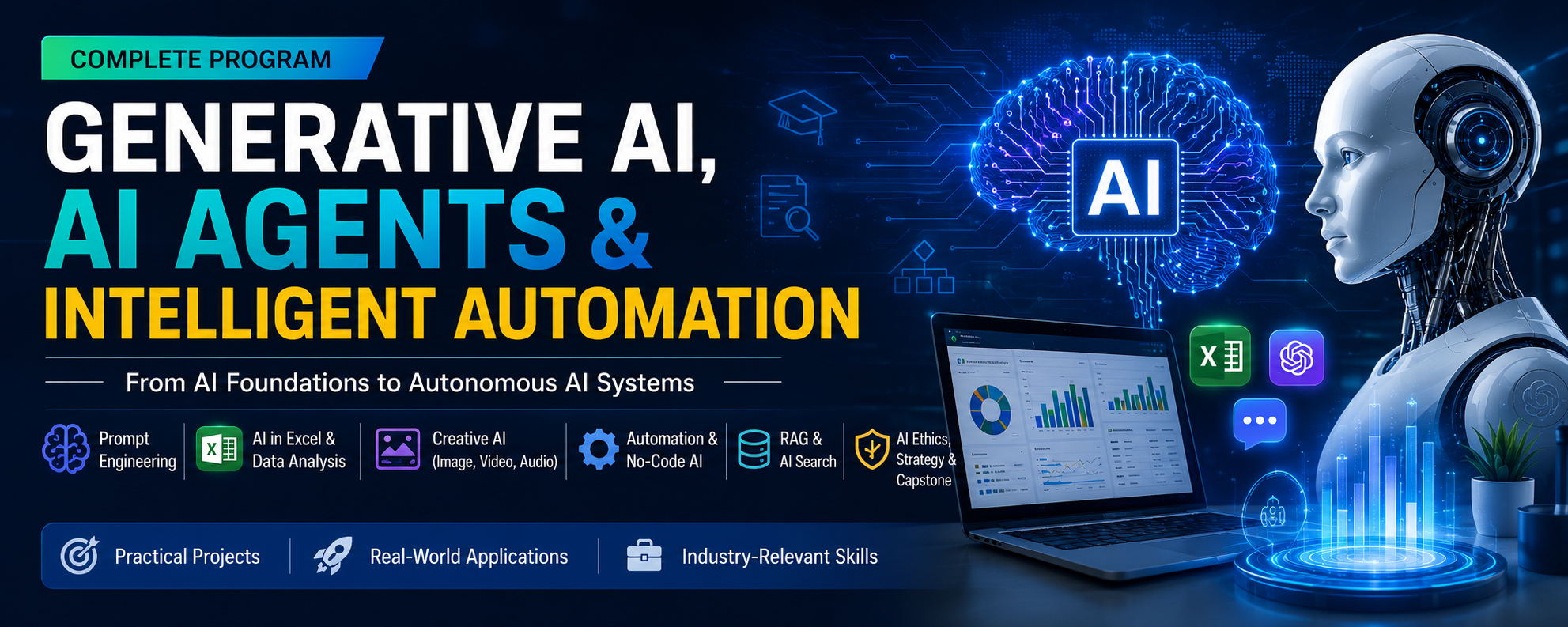
Module 2(PROMPT ENGINEERING MASTERY)

Instructor
About This Course
MODULE 2 — PROMPT ENGINEERING MASTERY
2.1 What is Prompt Engineering?
Prompt Engineering is the process of designing effective instructions for AI systems to produce useful, accurate and relevant outputs.
A strong prompt generally provides:
Clarity + Context + Format + Constraints + Iteration + Precision
2.2 What is a Prompt?
A prompt is an instruction, question, command or information provided to an AI system to generate a response.
Weak Prompt
"Explain Artificial Intelligence."
This does not specify:
- Audience
- Length
- Depth
- Format
- Purpose
Better Prompt
"Explain Artificial Intelligence in 150 words using three real-world examples for college students."
The second prompt gives the AI a clearer target.
2.3 Four Core Components of a Prompt
Task
What should the AI do?
Example:
"Summarise this article."
Context
What background information does the AI need?
Example:
"The summary is for Class 10 students."
Format
How should the response look?
Example:
"Use five bullet points."
Constraints
What limitations should the AI follow?
Example:
"Keep the response under 100 words."
2.4 Types of Prompts
Instruction-Based Prompt
Directly tells the AI what to do.
"Write an essay about climate change."
Question-Based Prompt
Asks a focused question.
"What are the benefits of AI in education?"
Contextual Prompt
Provides background before asking the question.
"I am preparing for an AI examination. Explain machine learning in simple language."
Conversational Prompt
Designed for back-and-forth interaction.
"Act as an AI tutor and teach me neural networks."
Creative Prompt
Requests imaginative content.
"Write a short story about a robot helping students learn."
2.5 Zero-Shot, One-Shot & Few-Shot Prompting
Zero-Shot Prompting
The AI receives the task without examples.
Example:
"Translate 'Good Morning' into French."
Advantage
Simple and fast.
Limitation
May be less effective for complex tasks.
One-Shot Prompting
The AI receives one example before performing the task.
Example:
Happy = Joyful
Sad = ?
The example establishes the expected pattern.
Few-Shot Prompting
The AI receives several examples.
Example:
Dog = Animal
Rose = Flower
Mango = Fruit
Sparrow = ?
Expected output:
Bird
Few-shot prompting can improve pattern recognition and reduce ambiguity, especially for more complex tasks.
2.6 Role-Based Prompting
Role-based prompting tells the AI to respond from a particular professional or expert perspective.
Example
"Act as an experienced mathematics teacher and explain exponents to Grade 8 students."
Possible roles include:
- Teacher
- Data analyst
- Software engineer
- Career counsellor
- Content writer
- Research assistant
Role instructions can help establish the desired perspective, vocabulary and level of detail.
2.7 Step-by-Step Prompting
For complex mathematical or logical tasks, prompts can ask the model to work through the problem systematically.
Example
"Solve this problem step by step: A train travels at 60 km/hr. How far will it travel in 5 hours?"
Calculation:
Distance = Speed × Time
60 × 5 = 300 km
The key idea is to make the task structure explicit and encourage systematic problem solving.
2.8 Prompt Refinement
A first prompt does not always produce the ideal response.
Use an iterative process:
Write → Test → Evaluate → Refine → Test Again
Example
Version 1:
"Write about AI."
Version 2:
"Explain AI for beginners."
Version 3:
"Explain AI in 200 words for first-year college students, using three real-world examples and simple language."
Each refinement adds more control.
2.9 Ten Best Practices for Prompt Engineering
1. Define the objective clearly
Know what result you need.
2. Provide sufficient context
Give relevant background information.
3. Use simple and precise language
Avoid ambiguous instructions.
4. Specify output format
Request:
- Bullets
- Tables
- Paragraphs
- JSON
- Code
5. Set constraints
Specify:
- Length
- Tone
- Reading level
- Scope
6. Use examples
Examples help clarify complex patterns.
7. Refine iteratively
Test and improve prompts.
8. Validate AI responses
Verify important facts and recommendations.
9. Maintain ethical standards
Do not use prompts for harmful or misleading purposes.
10. Document successful prompts
Maintain a reusable prompt library.
2.10 Ethical Prompt Engineering
Responsible prompting means:
Verify Important Information
Do not blindly trust AI-generated facts.
Protect Privacy
Do not unnecessarily provide sensitive or confidential information.
Avoid Harmful Content
Do not deliberately create misinformation, harmful content or deceptive material.
Respect Intellectual Property
Give credit where required and respect copyright.
Follow Policies
Follow organisational rules and applicable regulations.
Maintain Human Oversight
AI should augment human capabilities, not replace ethical judgement.
Module 2 Practical Activity
Prompt Improvement Challenge
Start with:
"Write a report about AI."
Improve it through three iterations.
Version 1
Add the audience.
Version 2
Add the purpose and format.
Version 3
Add length, tone, examples and constraints.
Then compare all three outputs.
Manish Sharma

Curriculum Overview
This course includes 0 modules, 0 lessons, and 0 hours of materials.
Course Certificate
Course Specifications



Subscribe to Our Newsletter


Additional Links
Login Register Contact Certificate Validation Become Instructor About Terms and PoliciesContact US


Reply to Comment