







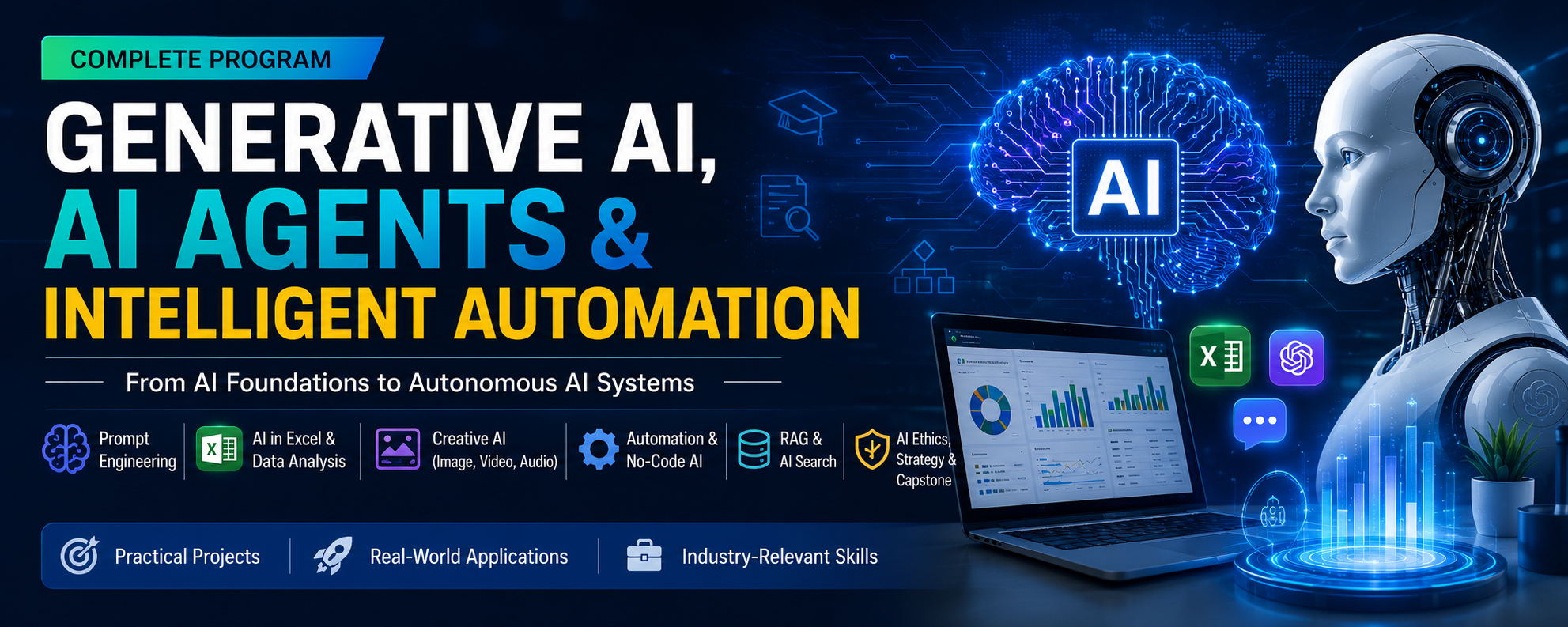
Module 1(AI BASICS & AI LITERACY)

Instructor
About This Course
MODULE 1 — AI BASICS & AI LITERACY
1.1 What is Artificial Intelligence?
Artificial Intelligence (AI) is the simulation of human intelligence by machines. AI systems can perform tasks that normally require human intelligence, such as learning, reasoning, problem-solving, decision-making, language understanding, image recognition, and prediction.
In Simple Words
AI allows computers to:
- Learn from data
- Identify patterns
- Understand language
- Make predictions
- Solve problems
- Generate content
- Support decisions
Example
When a streaming platform recommends a movie based on your previous viewing behaviour, AI is being used to identify patterns and personalise recommendations.
1.2 Why Does AI Matter?
AI is transforming the way individuals and organisations work.
Automates Repetitive Tasks
AI can handle repetitive activities and allow people to focus on creative and strategic work.
Improves Productivity
AI can process large amounts of information much faster than humans.
Analyses Large Datasets
AI can identify patterns and relationships that may be difficult to discover manually.
Supports Decision-Making
AI-generated insights can help people make more informed decisions.
Personalises Experiences
AI can customise recommendations, content and services.
Solves Complex Problems
AI is being applied to areas such as climate modelling, drug discovery and logistics optimisation.
1.3 History of Artificial Intelligence
1950 — Turing Test
Alan Turing proposed the idea of testing whether a machine could demonstrate behaviour indistinguishable from human intelligence.
1956 — Birth of AI
John McCarthy introduced the term Artificial Intelligence at the Dartmouth Conference.
1980s — Expert Systems
Rule-based expert systems became commercially popular for simulating specialised human decision-making.
2000s — Big Data Era
Increasing computing power and massive datasets accelerated machine learning and deep learning.
Present — AI Everywhere
AI now powers applications across healthcare, education, finance, transportation, entertainment and everyday digital services.
1.4 Types of AI — Based on Capability
Narrow AI
Also called Weak AI.
Designed to perform a specific task or limited set of tasks.
Examples
- Chatbots
- Face recognition
- Spam filters
- Search engines
- Chess AI
Narrow AI exists today.
General AI
Also called Strong AI.
A hypothetical system capable of learning and applying knowledge across a wide range of intellectual tasks.
It remains theoretical.
Super AI
A hypothetical form of AI that would surpass human intelligence across essentially all intellectual domains.
It is currently conceptual and is often discussed in future-oriented and ethical debates.
1.5 Types of AI — Based on Functionality
1. Reactive Machines
These systems respond only to current inputs and do not use past experiences as memory.
Example: IBM's Deep Blue chess system.
2. Limited Memory
These systems use stored or historical data to improve decisions.
Examples include:
- Recommendation engines
- Chatbots
- Autonomous driving systems
- Modern language models
3. Theory of Mind
A theoretical form of AI that would understand human emotions, beliefs and intentions.
4. Self-Aware AI
A hypothetical AI with consciousness, self-awareness and emotions. It does not currently exist.
1.6 AI vs Machine Learning vs Deep Learning
Think of these as nested concepts:
Artificial Intelligence
↓
Machine Learning
↓
Deep Learning
Artificial Intelligence
The broad field of creating intelligent machines.
Machine Learning
A subset of AI in which systems learn patterns from data.
Deep Learning
A subset of machine learning that uses large neural networks and is particularly powerful for complex tasks involving large datasets.
Easy Example
AI: Build a system that recognises objects.
ML: Train the system using examples.
Deep Learning: Use a deep neural network trained on a very large dataset to recognise complex visual patterns.
The relationship is:
AI ⊃ ML ⊃ Deep Learning.
1.7 AI in Everyday Life
Education
- Personalised learning
- Automated grading
- AI tutors
- Adaptive curriculum
Healthcare
- Medical-image analysis
- Disease prediction
- Drug discovery
- Patient monitoring
Banking
- Fraud detection
- Risk assessment
- Credit scoring
- Robo-advisory
Transportation
- Navigation
- Traffic management
- Autonomous vehicles
- Fleet optimisation
Entertainment
- Recommendations
- Gaming AI
- Music/video generation
- Streaming personalisation
Retail
- Customer-service bots
- Demand forecasting
- Inventory management
- Product recommendations
1.8 What is AI Literacy?
AI Literacy is the ability to understand, evaluate and responsibly use AI technologies in everyday and professional situations.
A person with AI literacy should understand:
- What AI can do
- What AI cannot do
- How to use AI tools
- How to evaluate AI-generated information
- How to recognise potential bias
- How to protect privacy
- How to use AI responsibly
1.9 Five Components of AI Literacy
1. Understanding AI Concepts
Understand AI, machine learning and the technologies behind AI systems.
2. Using AI Tools
Learn how to effectively interact with:
- Chatbots
- Generative AI
- Search systems
- Design tools
3. Evaluating AI Outputs
Check whether AI-generated information is:
- Accurate
- Biased
- Misleading
- Complete
4. Ethical Awareness
Understand:
- Privacy
- Fairness
- Accountability
- Responsible AI
5. Critical Thinking
Do not automatically accept an AI response. Question, verify and evaluate it.
1.10 Limitations of AI
AI is powerful, but it is not perfect.
Data Dependency
Poor or incomplete data can produce unreliable results.
Incorrect Outputs
AI can make mistakes, especially in ambiguous or unfamiliar situations.
Bias
AI can reproduce or amplify biases present in training data.
No Genuine Emotions
AI does not possess human emotions, empathy or human-like common sense.
No Guaranteed 100% Accuracy
AI systems cannot guarantee perfect accuracy in every situation.
1.11 Ethical AI
Responsible AI should consider:
- 🔒 Privacy
- ⚖️ Fairness
- 🔍 Transparency
- 🙋 Accountability
- 🛡️ Safety
Responsible AI Practices
- Verify important AI-generated information.
- Protect sensitive information.
- Use AI to support rather than replace critical thinking.
- Respect copyright.
- Follow organisational policies.
- Watch for bias in AI outputs.
Module 1 Practical Activity
AI Awareness Exercise
Choose five AI applications you use in everyday life.
For each application, identify:
- What task does AI perform?
- What data might it use?
- What benefit does it provide?
- What could go wrong?
- What human judgement is still required?
Manish Sharma

Curriculum Overview
This course includes 0 modules, 0 lessons, and 0 hours of materials.
Course Certificate
Course Specifications


Subscribe to Our Newsletter


Additional Links
Login Register Contact Certificate Validation Become Instructor About Terms and PoliciesContact US


Reply to Comment